

Online audiences are not short on opinions. What they are short on is analysis that feels open about what it knows, what it does not know and how it reached its conclusions in the first place. In a crowded media environment, readers are becoming more selective about whose judgement they trust and why.
That selectiveness is backed by data. A Digital Trust Lens survey by the Human Clarity Institute found that 61% of participants question whether online content is real or trustworthy often or almost always. Doubting what you read online is not occasional scepticism anymore, it has become a routine habit for the majority of internet users.
That is one reason transparent specialists stand out. Readers respond to writers like Maddison Dwyer, a seasoned iGaming writer and industry analyst with a journalism and digital content background who is known for breaking down complex topics into clear, trustworthy insights. Even outside gaming, that kind of method matters. People are more likely to trust analysis when it feels researched, readable and honest about complexity.
Readers want the reasoning, not just the conclusion

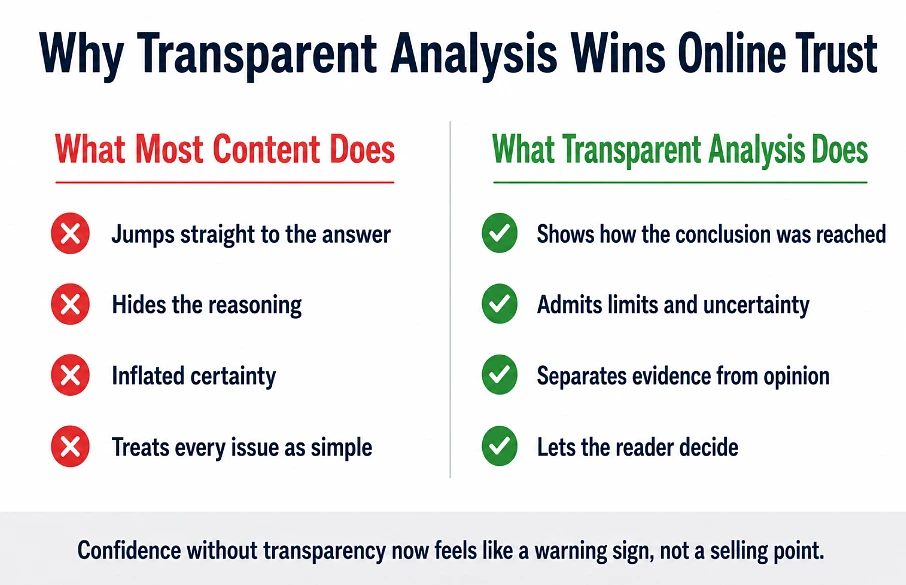
A lot of online content jumps straight to the answer. It tells readers what to think without showing how the writer got there. That approach may be fast but it often leaves people doubtful. If the reasoning stays hidden, the conclusion feels weaker no matter how confident the tone may be.
The same Human Clarity Institute research found that 65% of respondents say factual accuracy and evidence matter most when deciding what to believe online. And 83% said they trust content more when it reflects honesty, fairness or transparency. People are not just scanning for answers, they are evaluating whether the person giving the answer actually did the work to earn that position.
Transparent analysis works differently because it gives readers enough of the process to judge the quality of the thinking for themselves. That does not mean every article needs to be dense or academic. It means the writer signals what matters, where uncertainty exists and why one interpretation holds up better than another.
- explains the logic behind a conclusion
- acknowledges trade-offs and uncertainty
- avoids pretending every issue is simple
- separates evidence from opinion
Digital audiences have become very good at spotting performance. They can tell when a piece is trying to sound authoritative without doing much real explaining. Confidence still has value but confidence without transparency now feels more like a warning sign than a selling point.
Trust grows when writers admit limits
One of the strongest signals of trustworthy analysis is restraint. People are more likely to believe a writer who admits the edges of their knowledge than one who presents every claim as definitive. That is especially true in spaces where readers already feel cautious, overloaded or sceptical of polished narratives.
And that scepticism is not a small group. 61% of internet users now routinely question whether what they are reading online is real or trustworthy. The default state for most readers is doubt, not trust. Which means earning that trust requires more than just sounding confident, it requires showing your working.
Transparent online analysis earns trust by being clear about limits. A writer may say the evidence points in one direction but other factors still matter. Or they may note that a trend is real but not universal. These are small moves yet they change the whole tone of a piece. The reader feels informed rather than managed.
- The writer explains what is known and what is still uncertain.
- The article avoids forcing a bigger claim than the evidence supports.
- The tone stays measured instead of theatrical.
- The reader is treated as capable of making up their own mind.
This kind of writing does not weaken authority. It strengthens it. Readers tend to trust analysis more when it sounds like a serious attempt to understand, not a performance designed to win attention.
Transparency makes complex topics easier to navigate
There is a practical side to this as well. Transparent analysis helps readers think more clearly. In many cases people are not only looking for a verdict. They are trying to understand a system, compare competing interpretations or make better decisions based on incomplete information.
That could apply to markets, media narratives, product reviews or any subject where the surface story does not tell the whole truth. Transparent writing helps by slowing things down just enough to show what is actually driving the outcome.
- defining important terms in plain language
- showing how one factor affects another
- distinguishing signal from noise
- highlighting where readers should stay cautious
When writers do this well the result feels steadier and more useful. The article becomes something the reader can work with, not just react to.
This is one reason transparent voices often build loyal audiences over time. Readers remember the people who make difficult topics feel less chaotic without oversimplifying them. They come back because the experience feels clarifying rather than manipulative.
What readers really want is respect
At the heart of it, transparent analysis feels respectful. It respects the reader’s time by getting to the point clearly. It respects the reader’s intelligence by explaining rather than posturing. And it respects reality by admitting that some topics deserve nuance.
That respect carries real weight in how people behave online. A national survey by Liquid Web covering over a thousand Americans found that 69% have abandoned a transaction entirely because of distrust. And 52% are sceptical of testimonials and reviews, suspecting they are fake or curated. When people feel managed rather than respected, they leave. When reviews feel manufactured rather than earned, people stop believing any of them.
Too much content still depends on inflated certainty, emotional framing and shallow summaries dressed up as deep insight. Readers are tiring of that formula. They want writers who can hold attention without hiding the method.
What readers want from transparent online analysis is not perfection. It is a fair account of how the conclusion was reached and where the uncertainty still lives. In a world full of noise online, that kind of honesty has become one of the clearest markers of quality. It helps people think more carefully, trust more selectively and feel less like they are being pushed toward someone else’s script.
Don't Miss