

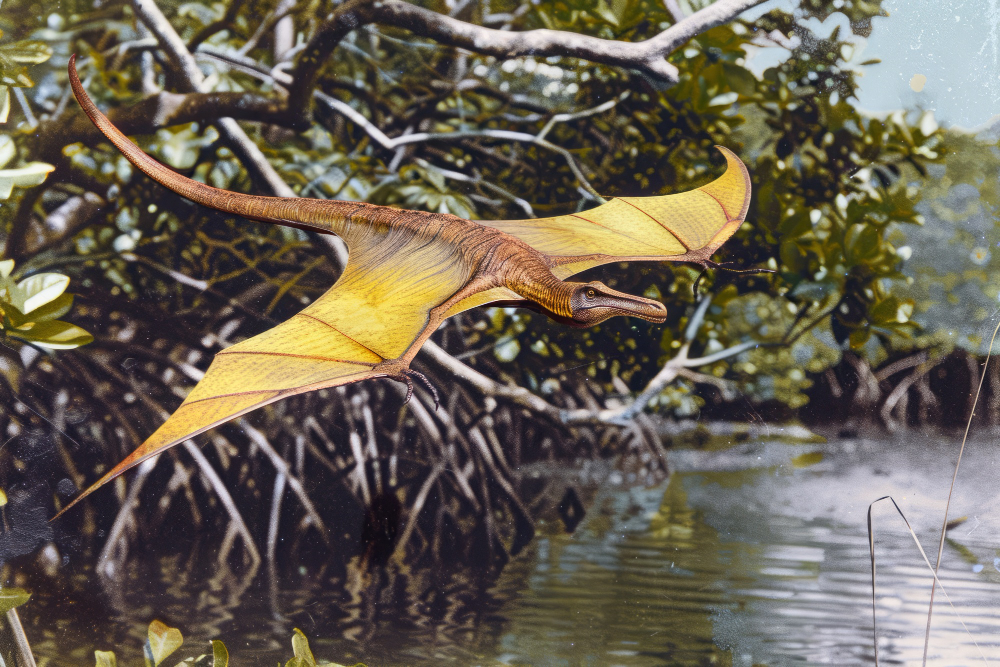
Imagine a creature soaring through the sky with a wingspan larger than a modern-day airplane. This is Quetzalcoatlus, a pterosaur whose size and flight abilities redefined what we thought possible for prehistoric creatures. The discovery of this giant flyer not only amazed scientists but also changed the course of paleontology by offering new insights into the mechanics of flight in the distant past.
Before Quetzalcoatlus, researchers assumed that the largest flying creatures of the Mesozoic Era were much smaller than this towering pterosaur. It was only with its discovery that paleontologists began to rethink the limits of flight in the ancient world. In this article, we will explore how Quetzalcoatlus altered our understanding of prehistoric flight and what this magnificent creature teaches us about the evolution of flight in the ancient skies.
The Discovery of Quetzalcoatlus: Unveiling the Giant
Early Fossil Finds and the Impact on Paleontology
The first fossil remains of Quetzalcoatlus were discovered in the 1970s in what is now Big Bend National Park, Texas. These remains were unlike anything scientists had ever encountered. Quetzalcoatlus, part of the Pterosauria order, was revealed to be a member of the Azhdarchidae family, a group known for its massive wingspans and long, slender necks. However, Quetzalcoatlus stood out even within this group.
What made its discovery so groundbreaking? The sheer size of its wingspan estimated to be as long as 33 feet prompted scientists to reevaluate their understanding of how such a large creature could have taken flight. Early theories about flight in prehistoric creatures were dominated by smaller, less imposing species. Quetzalcoatlus, however, proved that even massive creatures could rule the skies.
The Anatomy of Quetzalcoatlus: A True Giant of the Sky
Wingspan and Body Size: The Key to Its Flight
Quetzalcoatlus wasn’t just large in wingspan; its body size was also quite remarkable. It is estimated that its body could grow up to 16 feet long, with a wingspan that dwarfed most other flying creatures of the era. In fact, this pterosaur’s wingspan was greater than that of many modern-day airplanes, making it one of the largest known flying animals in history.
While most modern birds and insects have relatively small bodies in comparison to their wings, Quetzalcoatlus defied this convention. Its flight capabilities were not simply about wing size, but also its body structure, which was optimized for flight despite its enormous size. This combination of wingspan and lightweight build made it an efficient flier despite its bulk.
Wing Structure and Flight Mechanics: How Did It Fly?
Quetzalcoatlus had a unique wing structure compared to modern-day birds. Its wings were likely made up of a membrane of skin stretched between a long, thin arm and the fourth finger. The wing’s design was more akin to that of modern-day bats than birds, offering both flexibility and strength. This design allowed for efficient gliding and possibly even flapping flight.
However, it is still debated whether Quetzalcoatlus could engage in active flapping flight or if it was more of a glider, using air currents to stay aloft. What is certain is that its wings were incredibly efficient for long distances, allowing it to travel vast distances across the ancient landscape.
How Quetzalcoatlus Changed Our Understanding of Prehistoric Flight
Pterosaurs Before Quetzalcoatlus: Understanding the Evolution of Flight
Before Quetzalcoatlus, pterosaurs like Pteranodon and Pterodaustro were the focus of most research into flying reptiles. These creatures were much smaller than Quetzalcoatlus and had wingspans of around 15 feet, which, while impressive, were not as extraordinary as the giant pterosaur.
The discovery of Quetzalcoatlus, with its enormous wingspan and unique body structure, challenged previous assumptions. Scientists had previously thought that only smaller, more lightweight creatures could achieve flight. Quetzalcoatlus proved that this was not the case, showing that large animals could also take to the skies. This discovery led to a reevaluation of flight capabilities in prehistoric times, particularly among creatures of massive size.
The Role of Air Currents and Flight Theory
Quetzalcoatlus may have used a combination of gliding and powered flight. Its lightweight frame suggests that it could have soared for long distances using air currents, much like modern-day albatrosses. Additionally, its large wingspan would have given it significant lift, enabling it to stay aloft with minimal effort.
Recent studies suggest that Quetzalcoatlus, despite its size, might have been capable of active flight, much like a modern-day pelican or seagull. However, due to its size, it likely avoided flapping its wings constantly, instead relying on thermals and wind currents to support its flight.
Quetzalcoatlus’ Role in the Prehistoric Ecosystem
A Predator or Scavenger: How Did Quetzalcoatlus Survive?
Quetzalcoatlus’ large size and flight capabilities suggest it was both a predator and scavenger. Paleontologists believe that it likely hunted smaller dinosaurs, using its long, pointed beak to snatch up prey from the ground or even mid-air. Its size would have also allowed it to dominate other flying creatures in the region, giving it an advantage in the competitive ecosystem of the late Cretaceous period.
Some evidence suggests that Quetzalcoatlus may have scavenged carcasses as well, using its flight abilities to cover large areas in search of food. Its adaptability and flight capabilities would have allowed it to take advantage of a wide range of food sources, making it a versatile predator in its time.
The Extinction of Quetzalcoatlus: What Went Wrong?
The End of the Cretaceous: How Extinction Affected Pterosaurs
The extinction event at the end of the Cretaceous period marked the end of the reign of the dinosaurs, and many pterosaurs, including Quetzalcoatlus, did not survive. The exact cause of their extinction remains a mystery, but scientists believe that it was likely due to environmental changes, including volcanic activity, climate shifts, and the impact of the asteroid that led to the demise of the dinosaurs.
Quetzalcoatlus’ size and reliance on certain environmental factors for flight might have made it particularly vulnerable to these changes. While smaller pterosaurs could likely adapt to shifting conditions, the sheer size of Quetzalcoatlus may have limited its ability to adjust.
Quetzalcoatlus in Popular Culture and Modern Science
From Paleontological Curiosity to Cultural Icon
Beyond its importance in science, Quetzalcoatlus has also made its mark in popular culture. This giant pterosaur has been featured in documentaries, books, and even films like Jurassic Park. Its depiction as a towering flying creature captures the imagination of people worldwide, bringing attention to the prehistoric world.
The Legacy of Quetzalcoatlus: Ongoing Research and Discoveries
Scientists continue to study Quetzalcoatlus in detail, using advanced technologies like 3D modeling and biomechanics to better understand how it lived and flew. Ongoing research into its flight mechanics helps refine theories about prehistoric animals and their capabilities, influencing how we study flight in both extinct and living creatures.
FAQ Section
1. What Was the Wingspan of Quetzalcoatlus?
Quetzalcoatlus had a wingspan that could reach up to 33 feet, making it one of the largest flying animals ever discovered.
2. Was Quetzalcoatlus a Flapping Flyer or Glider?
It is believed that Quetzalcoatlus was more of a glider than a flapping flyer, using air currents to stay aloft for long distances.
3. What Did Quetzalcoatlus Eat?
Quetzalcoatlus likely hunted small dinosaurs and may have scavenged for carcasses as well.
4. How Did Quetzalcoatlus Change Our Understanding of Flight?
Quetzalcoatlus proved that large animals could fly, challenging previous assumptions that only smaller creatures could achieve flight.
5. Why Did Quetzalcoatlus Become Extinct?
Quetzalcoatlus, along with other pterosaurs, likely became extinct due to the environmental changes at the end of the Cretaceous period, including the asteroid impact.
Conclusion:
Quetzalcoatlus didn’t just soar through the skies of the late Cretaceous period it soared into the history books, reshaping our understanding of prehistoric flight. This giant pterosaur challenged everything we thought we knew about flight, proving that even the largest creatures could conquer the skies. From its massive wingspan to its role in the ancient ecosystem, Quetzalcoatlus continues to fascinate scientists and the public alike. As we continue to study its flight mechanics and ecological impact, this flying giant will remain a key figure in paleontological research, leaving us with many more questions to explore.
